
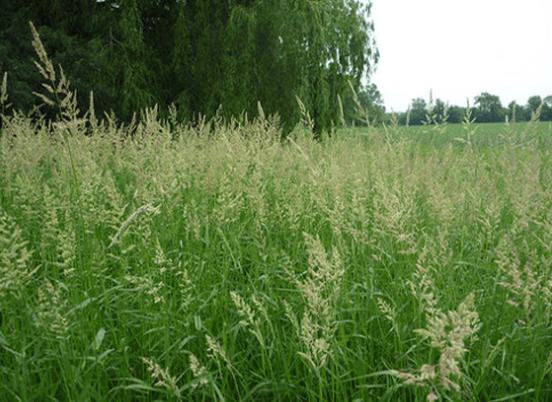
Get Reed Canary Grass CTD for $3.95 per Pound
Reed Canarygrass is a cool-season perennial grass. Though slow to establish, it is very persistent once established. It can reach 6″ to 8″ tall in fertile soil if not grazed or cut. Reed Canarygrass is primarily adapted for permanent hay or pasture on sites that are too wet for the good performance of other forage plants. It thrives in wet soils prone to flooding and is among the most drought-tolerant of cool-season grasses.
- Planting Depth: 0.5″
- Planting Rates: 8 to 10 Pounds per Acre, 4 to 8 Pounds per Acre in Mixes
- Planting Dates: March to May, September to October
Product ships in a 50-pound bag.
Establishment
When planted in the spring, it requires a firm, clean, moist seedbed. Weed competition is typically reduced if planted in the fall. If necessary, irrigate to maintain surface moisture until the plants are well established.
Adaptation
In areas that are too wet for bromegrass, fescue, and orchardgrass, Reed Canarygrass is well adapted. It is quite cold-tolerant, frequently withstanding temperatures below 30°F. Although moderately drought-tolerant, it requires 18” of annual precipitation or irrigation for the best performance. It can grow under a wide range of soil conditions but is mostly used on poorly drained soils or those subject to flooding.
Once established, Reed Canarygrass can withstand flooding for 60 to 70 days. It also performs well on soils that range from moderately acidic to weakly saline-alkaline. With natural flooding or frequent irrigation, it can withstand saltier soils.
Management
New seedlings should not be grazed until fully established. It is best to harvest as hay one to two times before grazing. To maintain plant vigor and promote rapid regrowth, leave a stubble of 3″ to 4” after mowing or grazing. Start spring grazing after plants reach a height of 10” to 12”. Maintain grass height below 12” during rapid spring growth. Harvest hay when the first seed heads appear.
Reed Canarygrass will persist under close, frequent use, though yield will be greatly reduced. Its persistence under heavy use makes it well-suited for calving, lambing, holding areas, or other special-use pastures. To maintain good yields, an annual application of fertilizer will be required on most fields, depending on soil test results. Due to its extensive root system and dense growth, Reed Canarygrass provides excellent erosion control.
Description
Phalaris arundinacea L., Reed Canarygrass, is a vigorous, productive, long-lived, perennial, sod-forming grass. It is a widespread species native to North America, Europe, and Asia. The numerous broad, moderately harsh, erect leaves are dominantly basal. The coarse, erect stems may reach a height of 6’ to 8’. The seed is borne in an open panicle that ripens from the top down and shatters readily as it matures.
There are approximately 480,000 seeds per pound. The seed has a short storage life and should be checked for germination within six months of its use. Reed Canarygrass has excellent frost tolerance and is well-suited to wet soils that are poorly drained or subject to flooding. It also has good drought tolerance. Growth begins in early spring and continues through the growing season. Regrowth following mowing or grazing is rapid on fertile sites. Forage quality is good prior to heading but then declines rapidly.
Reviews
There are no reviews yet.