
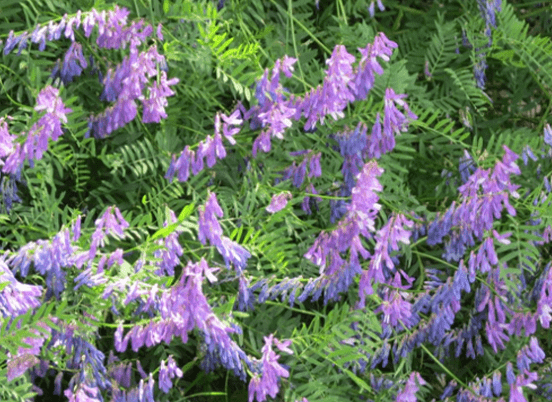
Currently Offered at $2.79 per Pound
Hairy Vetch is a viny, cool-season legume best used in crop rotations for erosion control or as a cover crop. It can also be used in feed as hay, silage, or grazing due to its high crude protein content. Hairy Vetch performs best on well-drained soils and under mild soil conditions.
- Planting Depth: 0.5” to 1.5”
- Planting Rates: 25 to 30 Pounds per Acre for Broadcast or Disking. Increase the Rate by 3 Pounds per Acre for Dormant Seeding.
- Planting Dates: Fall (August to September), Winter (Once Weather Consistently Stays Below 40°F). For Fall Planting, Plant at Least 40 Days Before the First Killing Frost.
Product ships in a 50-pound bag.
General Information
As mentioned above, Hairy Vetch is a viny, cool-season legume with stems 2’ to 4’ long. Leaves are composed of 10 to 20 narrow leaflets and are terminated by branched tendrils. Flowers are usually purple in color.
Hairy Vetch provides good ground cover for erosion control during the fall, winter, and spring, and is valuable for use in no-till systems due to its high biomass production. It also improves soil tilth and fixes large amounts of nitrogen (N), which can be utilized by subsequent crops in a rotation. Due to its high crude protein content, Hairy Vetch can be used for hay, silage, or grazing, further enhancing soil fertility through the natural fertilization process.
Adaptation
Hairy Vetch does best on well-drained soils and is not recommended for poorly drained soils. It prefers a soil pH between 6.0 and 7.0 and is adapted to high soil fertility (phosphorus (P), potassium (K), and sulfur (S)). Due to its winter hardiness and being more drought-tolerant than other vetches, it is widely adapted throughout the US. Hairy Vetch develops best under cool temperatures on fertile loamy soils. It can also be very productive on sandy or clay soils and is known to grow well on light soils that are too sandy for crimson clover.
Establishment
While it is possible to plant in the spring, Hairy Vetch is best planted in late summer to early fall or early winter for dormant seeding. It is often planted with cereal rye, oats, or other winter grains for improved winter survivability, greater winter annual weed control, and increased erosion control. For mixtures, one should reduce the Hairy Vetch seeding rate by up to 25% and the grain seeding rate by 50% from the rates recommended for pure stands. If using as a cover crop, Hairy Vetch does not normally require fertilizer unless the field has a severe K or P deficiency.
A good place in a crop rotation for Hairy Vetch establishment is after a small grain harvest. Make sure the crop residue from the previous crop is well distributed if Hairy Vetch is established with no-till methods and kill existing vegetation with a burndown herbicide. More often than not, a fair amount of small-grain volunteers will come up with the Hairy Vetch in the fall. This should be considered an advantage rather than a disadvantage.
The small grains provide a quick cover, whereas the Hairy Vetch grows slowly in the fall. The small grains help retain and absorb nutrients such as nitrogen, phosphorus, and potassium. The small grains also provide mulch that is more resistant to decomposition and contributes to the buildup of soil organic matter. The C/N (carbon-to-nitrogen) ratio of the residue tends to be lower if the small grain is grown in conjunction with Hairy Vetch, contributing to faster decomposition of the small grain residue and less nitrogen immobilization.
It is possible to establish Hairy Vetch after an early corn silage harvest. However, attention needs to be paid to the herbicide program used; check the rotational restrictions on the label. Although Hairy Vetch is not generally included as a rotational crop on the herbicide label, alfalfa and clover rotational restrictions should be similar to those for Hairy Vetch.
Another option is to broadcast Hairy Vetch in standing soybeans, but this is uncommon because of the expense of the seed and the higher risk of failure with this method than if vetch is drilled. Seeding Hairy Vetch after corn grain or soybean harvest is not recommended because the vetch is then unlikely to survive the winter.
Management
Hairy Vetch performs best in rotations with conventional and no-till planted row crops. Using this system, the Hairy Vetch is either mechanically or chemically terminated during full bloom to allow for peak nitrogen accumulation and maximum vetch kill before planting the row crop. If being grown for hay, Hairy Vetch should be cut in the early bloom stage, and if for grazing, wait until the plants are at least 6” high.
Reviews
There are no reviews yet.