
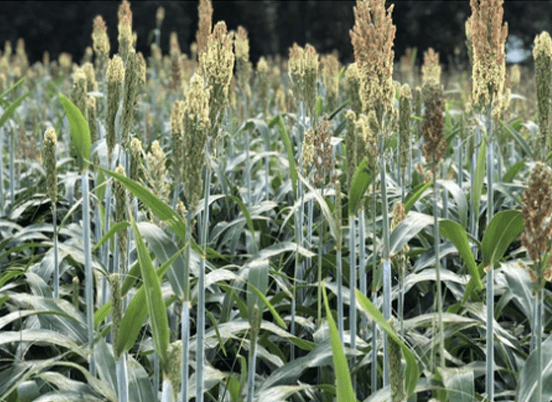
Get Sorghum/Sudan at $1.29 per Pound
Greengrazer V—We believe this is the best of its kind, but other options are available…just ask!
Sorghum/Sudan is the highest producer of biomass among summer cover crops. This warm-season annual can produce a substantial amount of forage in a short period during the summer months. Heat, moisture, and fertility contribute to its productivity. When moisture is scarce, Sorghum/Sudan waits for rain. This new variety will revolutionize the way you think about this excellent, low-cost crop. It can be grazed, hayed, green chopped, or used for silage.
Use it as part of a double-crop program to thicken thinning alfalfa fields or to replace a weak or undesirable pasture. When following with a fall forage such as Italian ryegrass, alfalfa, or pasture, we recommend disking the crop down in late August to early September to ensure a good start for the next crop. Most grazing farms should have a percentage of their farm in Sorghum-Sudangrass to help fill in the summer slump when the cool-season pasture is slowing down.
- Planting Depth: 0.75″ to 1.25″
- Planting Rates: 25 to 60 Pounds per Acre, Higher for Fields with Weed Problems
- Planting Dates: May to July, with Soil Temperature at Least 60°F
Product ships in a 50-pound bag.
Adaptation
Sorghum-Sudangrass is adapted throughout the United States and southern Canada. It performs best in moderate to well-drained soils with a soil pH between 5.5 and 7.5. Its drought tolerance is high, with the water requirement being approximately 0.333 less than that for corn.
Management
For optimum forage production, moderate fertility is suggested, although Sorghum-Sudangrass will grow in lower fertility soils with better results than corn. Fertilize using soil test recommendations. If a soil test is not available, fertilize at rates similar to those for other annual grass crops. Grazing should begin when the plants are 18” to 30” tall and grazed down to 8” within 10 days. After grazing, the residue needs to be clipped to a minimum uniform height of 8” to ensure high-quality forage production for the next grazing period in three to four weeks.
Do not graze after a killing frost until the plants turn completely brown (seven days). If the plants are frost-damaged, wait until the regrowth is at least 18” high before grazing again. Green chop harvesting should begin when the Sorghum-Sudangrass is 18” tall and should be completed before the plants head out. Silage should be harvested when the plants are 36” to 48” tall or in the boot to early head stage.
At this stage, moisture is usually too high, and the plants should be allowed to partially dry in the field before ensiling. Harvesting for hay is recommended before head emergence or when the plants reach 48” in height. Rapid, uniform drying is critical for Sorghum-Sudangrass hay to prevent spoilage.
Avoid possible nitrate and prussic acid poisoning by avoiding large applications of nitrogen prior to expected drought periods; do not harvest drought-damaged plants within four days following a good rain; do not cut or graze within seven days of a killing frost; cut at a higher stubble height if under stress since nitrates accumulate in the lower stalk, and delay feeding silage six to eight weeks after ensiling to allow prussic acid to dissipate. Never feed Sorghum-Sudangrass to horses.
Description
Sorghum-Sudangrass is a cross between sorghum and sudangrass. It is a finer-stemmed, warm-season annual grass compared to forage sorghum and will regrow after each harvest. It can grow up to 15’ tall and typically has small seed heads. The seed is produced on a panicle that is open and erect. The leaves are similar to corn but are shorter and sometimes wider. Varieties with the brown midrib gene have significantly greater digestibility, which increases utilization and efficiency. There are approximately 21,000 seeds per pound.
Reviews
There are no reviews yet.